
A smooth and durable paint finish starts long before the final coat of paint is applied. Surface preparation plays a major role in wall strength, paint adhesion and long-term appearance. Two commonly used materials before painting are wall putty and white cement, but many homeowners, contractors and builders still get confused about which one to choose.
As a trusted Putty Manufacturer in India, Nano Polycoat understands how proper surface preparation directly affects paint durability and finish quality.
Both products serve different purposes and choosing the right one depends on wall condition, project type, finish expectations and environmental conditions.
What is Wall Putty?
Wall putty is a white cement-based or polymer-based material applied before painting to create a smooth, even and durable surface. It helps fill minor cracks, pores, dents and imperfections on walls.
Wall putty improves:
- Paint adhesion
- Surface smoothness
- Paint durability
- Finish quality
It is widely used in residential, commercial and industrial projects before applying primer and paint.
Types of Putty Used Before Painting
White Cement-Based Putty
This is the most common wall putty used in interior and exterior applications.
Benefits:
- Smooth finish
- Strong bonding
- Better paint life
- Moisture resistance
Acrylic Wall Putty
Acrylic putty is ready-to-use and commonly applied for interior walls.
Benefits:
- Easy application
- Fast drying
- Crack resistance
Epoxy Putty
Epoxy putty is mainly used for industrial and repair applications where high durability and chemical resistance are required.
Common Uses:
- Metal repair
- Industrial surfaces
- Heavy-duty applications
NC Putty
NC putty is commonly used in automotive and metal finishing applications for surface leveling before painting.
Benefits:
- Smooth finishing
- Fast sanding
- Good filling properties
KPF Putty
KPF putty is used in specialized industrial and automotive applications requiring durable surface preparation.
Benefits:
- Surface correction
- Enhanced paint finish
- Better coating adhesion
What is White Cement?
White cement is a cement-based material mainly used for wall leveling, decorative finishes, tile grouting and base preparation. It contains low iron content, which gives it a white appearance.
Unlike wall putty, white cement alone does not provide the same smoothness and paint-ready finish.
It is commonly used for:
- Wall repairs
- Decorative textures
- Base leveling
- Tile joint filling
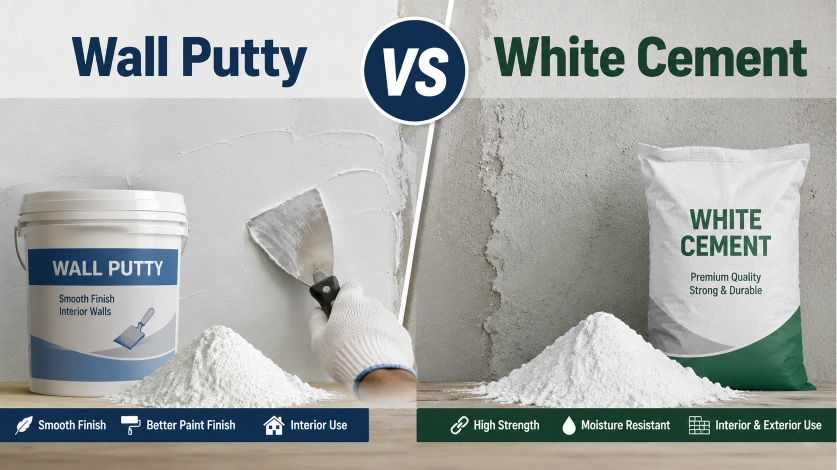
Wall Putty vs White Cement: Key Differences
| Feature | Wall Putty | White Cement |
| Main Purpose | Surface smoothness before painting | Base wall preparation and repair |
| Finish Quality | Smooth and paint-ready | Rough compared to putty |
| Paint Adhesion | Excellent | Moderate |
| Crack Resistance | Better flexibility | Lower flexibility |
| Moisture Resistance | Good moisture protection | Basic resistance |
| Application Area | Interior and exterior walls | Construction and repair work |
| Surface Smoothness | High | Medium |
| Paint Consumption | Reduces paint usage | Does not improve paint coverage significantly |
| Drying Process | Controlled smooth finish | Hard cement-like finish |
| Best Use | Before primer and paint | Base preparation |
Why Wall Putty is Preferred Before Painting
Most professional painters and contractors prefer wall putty because it creates a smoother surface and improves paint performance.
Better Surface Finish
Wall putty fills small pores and imperfections, helping achieve:
- Uniform paint finish
- Better wall smoothness
- Improved paint appearance
Improves Paint Durability
A properly prepared wall surface reduces paint peeling and cracking over time.
Wall putty helps:
- Increase paint life
- Improve primer adhesion
- Enhance coating durability
Reduces Paint Consumption
Smooth walls absorb less paint compared to rough cement surfaces.
This helps:
- Reduce overall paint usage
- Lower repainting costs
- Improve finish consistency
Better Moisture Resistance
High-quality putty helps protect walls from moisture penetration and surface damage.
This is especially important in humid environments and exterior applications.
According to the National Institute of Standards and Technology (NIST), proper surface preparation significantly improves coating durability and long-term performance.
When Should You Use White Cement?
White cement is still useful in certain applications.
Suitable applications include the following:
- Wall crack repairs
- Decorative textures
- Base leveling
- Tile and stone work
- Minor masonry applications
However, for premium paint finishing, wall putty is usually applied after the base preparation stage.
Choosing the Right Putty Manufacturer
The quality of putty directly affects paint finish and wall durability.
Important Factors to Consider
- Product consistency
- Smooth application
- Crack resistance
- Moisture protection
- Surface adhesion
- Bulk supply capability
Working with an experienced putty manufacturer ensures reliable product quality and technical guidance for different applications.
Why Businesses Choose Nano Polycoat
We are a trusted putty manufacturer in Gujarat, offering high-performance wall putty solutions for residential, commercial, automotive and industrial applications.
Our Strengths Include:
- Quality-focused manufacturing
- Consistent product performance
- Advanced formulation process
- Reliable bulk supply capability
- Technical support and guidance
- Smooth finish quality
As a putty manufacturer in Ahmedabad, we supply products designed for better adhesion, surface durability and long-lasting paint performance.
Our solutions are widely used by contractors, dealers, industrial projects, painters and construction professionals across India.
Conclusion
Both wall putty and white cement play important roles in surface preparation, but they serve different purposes. White cement is mainly used for base repairs and leveling, while wall putty creates a smoother, paint-ready surface with better durability and finish quality.
For professional painting results and longer-lasting coatings, wall putty is generally the preferred option before painting. Choosing a trusted supplier like Nano Polycoat helps ensure consistent performance, improved wall protection and a cleaner, more refined final finish.
FAQs
- What is the main difference between wall putty and white cement?
Wall putty is mainly used for smooth surface finishing before painting, while white cement is used for wall repairs, leveling and construction-related applications. Putty provides better paint adhesion and smoother finishing.
- Is wall putty necessary before painting?
Yes, wall putty helps create a smooth surface, improves paint bonding, reduces paint consumption and increases paint durability for both interior and exterior walls.
- Can white cement replace wall putty?
White cement alone cannot fully replace wall putty because it does not provide the same smooth finish, flexibility and paint-ready surface quality required for premium painting applications.
- Which putty is best for smooth wall finishing?
White cement-based wall putty is commonly preferred for smooth wall finishing because it offers good adhesion, crack resistance, moisture protection and improved paint performance.
- What is NC putty used for?
NC putty is mainly used in automotive and metal surface applications to fill dents, smooth uneven surfaces and improve paint finish quality before automotive coating processes.
- Who is a reliable putty manufacturer in Gujarat?
Nano Polycoat is a trusted putty manufacturer in Gujarat offering quality wall putty, industrial putty, NC putty and surface preparation solutions for multiple industries across India.
- Do putty manufacturers provide bulk supplies for projects?
Yes, many Putty Bulk Supplier companies provide large-scale supply solutions for construction projects, industrial applications, painting contractors, dealers and commercial infrastructure work.