

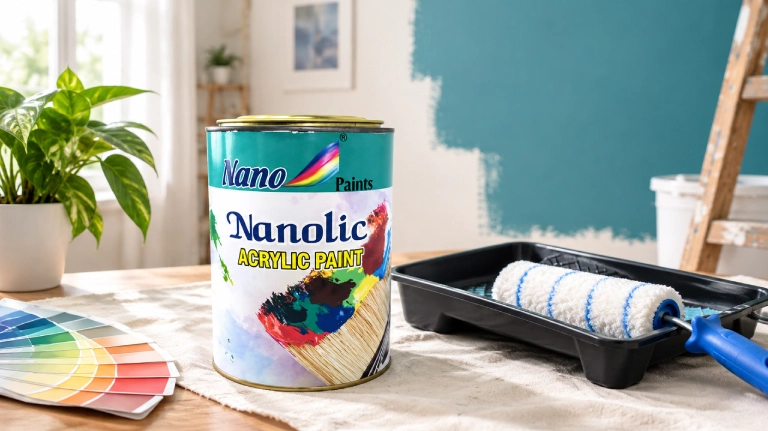
Water-based acrylic paint is generally a better choice for indoor air quality than conventional solvent-based paint because it typically produces lower levels of VOC emissions and chemical vapors. However, water-based does not automatically mean zero-VOC or completely emission-free. Product formulation, VOC content, additives, ventilation and application conditions all matter.
For businesses and property owners selecting interior coatings, working with established acrylic paint manufacturers in India can help when you need product information, technical documentation and guidance for indoor applications.
What Is Water-Based Acrylic Paint?
Water-based acrylic paint is a coating in which water is the primary carrier rather than a conventional organic solvent.
As the coating dries, water evaporates and the acrylic binder forms the paint film. Depending on its formulation, the finished coating can provide good adhesion, colour retention, coverage and durability for suitable interior surfaces.
Water-based acrylic coatings are widely used for walls, ceilings, wood, metal and other properly prepared substrates.
Their environmental and indoor-air advantage comes partly from their generally lower solvent content compared with many conventional solvent-based coatings.
Why Does Paint Affect Indoor Air Quality?
Paints and coatings can release volatile organic compounds (VOCs) into indoor air during application and drying.
VOCs are chemicals that can evaporate into the air. Some VOCs are associated with short- or long-term health effects and indoor concentrations of many VOCs can be higher than outdoor concentrations.
The impact depends on the specific chemicals, their concentration, the amount of product applied, ventilation and the characteristics of the room.
This is why paint selection becomes particularly important in enclosed spaces.
Are Water-Based Acrylic Paints Better for Indoor Air Quality?
In general, yes, when compared with conventional solvent-based alternatives.
The U.S. Environmental Protection Agency states that water-based acrylic latex paints are generally lower in VOCs than solvent-based paints. It also notes that water-based paints are generally safer to handle and can be cleaned with water.
However, the important word is generally.
Two water-based paints can have different formulations and emission profiles. Therefore, buyers should evaluate the actual product rather than assuming that every water-based acrylic paint has the same indoor-air characteristics.
Water-Based vs. Solvent-Based Paint
| Factor | Water-Based Acrylic Paint | Solvent-Based Paint |
| Main carrier | Water | Organic solvent |
| Typical VOC level | Generally lower | Generally higher |
| Odor during application | Usually lower | Often stronger |
| Cleanup | Often possible with water | Usually requires suitable solvent |
| Indoor suitability | Commonly suitable when specified for indoor use | Product-specific |
| Ventilation | Still important | Particularly important |
| Drying | Often relatively quick | Depends on formulation |
| VOC-free? | Not necessarily | Generally not |
This table should be viewed as a general comparison rather than a guarantee for every formulation.
The technical data sheet and safety documentation for the specific product should always take priority.
What Are the Main Indoor Air Benefits?
1. Lower VOC Emissions
One of the main advantages is the potential for lower VOC emissions compared with many solvent-based alternatives.
EPA guidance for indoor environments recommends selecting low-VOC or water-based coatings where appropriate because they can reduce the indoor pollution load.
2. Less Strong Paint Odor
Water-based acrylic products generally have less solvent odour than many solvent-based coatings.
This can make the painting process more comfortable, although low odour should not be treated as proof that a product has zero emissions.
3. Easier Cleanup
Many water-based acrylic paints can be cleaned from tools using water rather than strong organic solvents.
That can reduce the need to use additional solvent-containing cleaning products during the painting process.
4. Practical Indoor Application
Water-based acrylic systems are available for many interior applications, making them practical for homes, offices, retail spaces and other occupied-building projects when the product is specifically designed for the intended surface.
Does Water-Based Mean Zero VOC?
No.
This is one of the most important points when evaluating interior paint.
A water-based product can still contain or emit certain volatile compounds. EPA also cautions that “low-VOC” or “no-VOC” labels do not by themselves establish that a product is free from potentially undesirable volatile chemicals.
Therefore, don’t choose a product solely because its label says “water-based.”
Instead, look for documented information about:
- VOC content
- Emissions testing, where available
- Intended indoor application
- Product ingredients or safety information
- Third-party certifications
- Manufacturer technical documentation
How to Choose Water-Based Acrylic Paint for Indoor Use
1. Check the VOC Information
Ask the acrylic paint supplier in India for the relevant product documentation rather than relying only on general marketing terms.
2. Look for Low-Emission Certifications
Where indoor air quality is a major project requirement, third-party certification can provide additional evidence.
EPA’s Indoor AirPLUS specifications, for example, reference recognized third-party low-emission certifications and testing approaches for interior paints and coatings.
3. Confirm the Intended Application
An exterior coating should not automatically be used indoors.
Check that the product is specifically recommended for the intended indoor substrate and environment.
4. Consider Durability
Lower emissions are important, but the coating must still perform.
EPA recommends considering VOC content together with composition, durability and required performance characteristics rather than selecting a product based solely on VOC claims.
Where Water-Based Acrylic Paint Works Well
Water-based acrylic coatings can be considered for a range of indoor applications, including:
- Residential walls and ceilings
- Offices
- Retail interiors
- Schools and institutional spaces
- Furniture and decorative surfaces
- Interior woodwork
- Properly prepared metal surfaces
- Commercial interiors
The exact product should be matched to the substrate and service conditions.
For industrial or specialised applications, a standard decorative acrylic may not provide the required chemical, abrasion or mechanical resistance.
Indoor Painting: Ventilation Still Matters
Choosing a water-based product does not eliminate the need for ventilation.
EPA recommends providing plenty of fresh air when painting or using products that may release VOCs.
During an indoor painting project:
- Increase fresh-air circulation.
- Follow the product label.
- Use the recommended protective equipment.
- Keep unnecessary occupants away during application.
- Allow adequate drying time before normal occupancy.
- Avoid storing open paint containers indoors.
- Follow the manufacturer’s safety instructions.
Good ventilation is particularly important in small rooms or areas with limited air exchange.
Common Mistakes When Choosing Indoor Acrylic Paint
Assuming “water-based” means chemical-free
Water is the primary carrier, but the coating still contains other ingredients necessary for film formation and performance.
1. Choosing only by price
A low-cost product may not provide the required coverage, durability or emission performance.
2. Ignoring certification
For projects with strict indoor-air requirements, documented third-party testing can be more useful than an unverified “eco-friendly” claim.
3. Focusing only on VOC content
VOC content is important, but EPA notes that total VOC levels alone do not necessarily indicate the toxicity of individual VOCs.
4. Forgetting ventilation
Even relatively low-emission products should be applied according to the manufacturer’s ventilation and safety instructions.
What Should Buyers Ask an Acrylic Paint Manufacturer?
Before purchasing for a large residential, commercial or institutional project, ask the following:
- Is the product specifically designed for interior use?
- What is its VOC content?
- Is emissions testing available?
- Does it have any recognised third-party certification?
- What substrates can it be applied to?
- What primer is recommended?
- What is the expected coverage?
- How long should the area remain ventilated?
- What are the drying and curing requirements?
- What cleaning products are compatible with the cured coating?
A reliable acrylic paint manufacturer in Gujarat should be able to provide clear technical and safety information instead of relying only on broad environmental claims.
Final Takeaway
Water-based acrylic paint can be a sensible choice for indoor projects because it generally produces fewer VOCs and lower chemical vapours than conventional solvent-based paint. But water-based does not automatically mean zero-VOC or emission-free.
The strongest approach is to evaluate the complete product: VOC information, emissions data, certification, durability, intended application and manufacturer documentation.
Good ventilation during and after painting remains important, regardless of the coating selected.
Nano Polycoat provides acrylic coating solutions as an acrylic paint manufacturer in Ahmedabad, supporting commercial and industrial customers across India and selected international markets.
FAQs
- Is water-based acrylic paint better for indoor air quality?
Generally, water-based acrylic paint can be better for indoor air quality than many conventional solvent-based paints because it typically has lower VOC emissions and fewer chemical vapours. However, formulations vary, so buyers should check the specific product’s VOC information, certifications, intended use and manufacturer documentation.
- Does water-based acrylic paint have zero VOC?
Not necessarily. Water-based describes the primary carrier, not a guarantee that the product contains no volatile organic compounds. Some water-based paints can still contain or emit VOCs from other ingredients. Check the manufacturer’s technical information and any third-party emissions certification before making a zero-VOC claim.
- How do I choose an acrylic paint manufacturer in India?
Choose an acrylic paint manufacturer in India that provides clear technical data, VOC information, safety documentation, application guidance and consistent product quality. For indoor projects, also ask about emissions testing, low-emission certifications, substrate compatibility, durability and the product’s recommended ventilation and occupancy conditions.
- Is water-based acrylic paint safe for bedrooms and offices?
Water-based acrylic paint is commonly used for interior spaces such as bedrooms and offices because it generally emits fewer chemical vapors than many solvent-based alternatives. However, the specific product matters. Choose an interior-rated, low-emission product and maintain good ventilation during application and drying.
- Does low-VOC paint improve indoor air quality?
Low-VOC paint can reduce the amount of VOC pollution introduced by painting, but it does not guarantee better indoor air quality by itself. Other materials, ventilation, cleaning products and furnishings also contribute to indoor emissions. Product composition and recognized emissions testing should be considered together.
- Is water-based acrylic paint suitable for commercial interiors?
Yes, water-based acrylic coatings can be suitable for many commercial interiors, including offices, retail spaces and institutional buildings. The coating should be selected according to substrate, traffic, cleaning requirements, appearance and indoor-air specifications. For high-demand areas, a more specialized coating system may be necessary.
- What should I ask an acrylic paint supplier in India?
Ask about VOC content, emissions certification, intended indoor use, substrate compatibility, primer requirements, coverage, drying time, durability and ventilation recommendations. For larger projects, also request technical and safety documents and confirm whether the product meets the project’s indoor-air-quality specifications.