
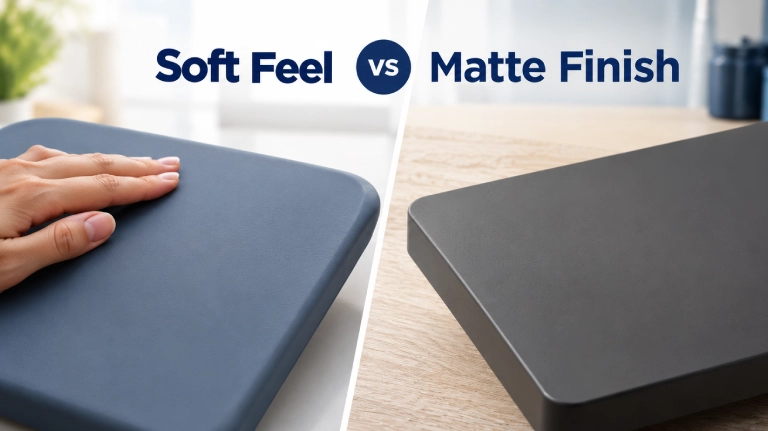
Soft feel and matte finish are not the same thing. Matte describes how little light a surface reflects and therefore how the coating looks, while Soft Feel describes how the coated surface feels when touched. A product can have a matte appearance without having a soft, velvety tactile effect. For manufacturers, this distinction is important when selecting a finish based on both appearance and user experience.
If you are comparing coating systems for commercial or industrial applications, Soft Feel Manufacturers in India can help you evaluate the required combination of gloss, touch, durability and application method.
What Is a Matte Finish?
A matte finish is primarily an appearance characteristic.
It reflects less light than satin or gloss finishes, creating a subdued surface with little visible shine. This can give products a modern, understated appearance and can reduce the visual emphasis of minor reflections.
Matte finishes are used across furniture, automotive components, consumer products, industrial equipment, packaging and architectural applications.
However, matte does not automatically mean soft to the touch.
A matte-coated surface can feel completely smooth, slightly textured or relatively hard depending on its formulation and surface structure.
What Is a Soft Feel Finish?
A soft feel or soft touch coating is designed to create a distinctive tactile experience.
Instead of simply reducing gloss, the coating is formulated or engineered to give the surface a soft, smooth, velvety or rubber-like sensation when touched.
For example, PPG describes soft-touch polyurethane coatings for electronic devices as providing a low-sheen appearance combined with a luxurious feel.
Axalta similarly describes SoftTouch technology as producing a velvety tactile experience and lists applications including furniture, lighting, shop fittings and electronics.
This makes Soft Feel particularly relevant to products where the customer physically interacts with the surface.
Soft Feel vs Matte Finish: What’s the Difference?
| Feature | Soft Feel | Matte Finish |
| Main purpose | Create a tactile experience | Reduce surface reflection |
| Primary characteristic | Feel/touch | Appearance |
| Gloss | Usually low, but formulation-dependent | Low |
| Surface feel | Soft, velvety or smooth | Can range from smooth to textured |
| Fingerprint resistance | Can be engineered into the system | Depends on formulation |
| Premium tactile effect | Strong | Not necessarily |
| Typical applications | Electronics, furniture, handles, consumer products | Furniture, automotive, industrial products, interiors |
| Selection priority | Touch + appearance + performance | Appearance + gloss level + performance |
The most important takeaway is simple:
Matte tells you how the surface looks. Soft Feel tells you how the surface feels.
Is Every Soft Feel Coating Matte?
Not necessarily.
Many Soft Feel systems have a low-gloss or matte appearance because the visual effect complements the tactile surface. But the two characteristics should still be specified separately.
Modern coating technology can create ultramatte surfaces with a soft-touch effect. PPG’s excimer technology, for example, creates a microscopically textured surface that diffuses light to produce an ultramatte appearance while also creating a distinctive soft-touch feel.
Therefore, when specifying a coating, saying “matte” alone may not communicate the required tactile performance.
When Should You Choose Soft Feel Coating?
Soft Feel is particularly useful when touch is part of the product experience.
1. Consumer Electronics
Mobile devices, laptop housings, remote controls and other frequently handled products can benefit from a comfortable tactile surface.
PPG identifies soft-touch coatings for electronic device bodies and keypads, with performance characteristics that include stain and scratch resistance.
2. Furniture
Soft Feel coatings can give furniture components a distinctive premium tactile character.
They can be considered for cabinet parts, handles, decorative panels and other surfaces where customers frequently interact with the product.
3. Automotive Components
Soft-touch coatings can be used for selected interior components where appearance, tactile comfort and resistance to regular handling are important.
The exact coating system should be selected according to the substrate and required automotive performance.
4. Industrial and Consumer Products
Switches, handles, control panels, accessories and product housings are other potential applications where tactile performance can add value.
When Is a Matte Finish the Better Choice?
A conventional matte finish may be more appropriate when the main objective is visual appearance rather than tactile effect.
For example, a manufacturer may want:
- Low light reflection
- A modern appearance
- A uniform visual finish
- Reduced visual emphasis on surface imperfections
- A specific low-gloss appearance
- A cost-effective alternative to a specialty tactile coating
Industrial coating systems can offer multiple gloss levels, from very matte through high gloss, showing that gloss level can be independently specified as part of a coating system.
Soft Feel vs Matte: Which Is More Durable?
There is no universal winner.
Durability depends on the specific coating formulation and intended application, not simply whether the product is called “Soft Feel” or “Matte.”
Important performance factors include:
- Scratch resistance
- Abrasion resistance
- Chemical resistance
- Stain resistance
- Fingerprint resistance
- Adhesion
- Flexibility
- UV resistance
- Cleaning requirements
Some soft-touch systems are specifically formulated to combine tactile properties with abrasion, stain or fingerprint resistance. Axalta, for example, lists abrasion resistance and fingerprint resistance among the properties of its SoftTouch coating.
For commercial production, always request the technical data sheet and, where possible, evaluate an actual coated sample.
What Affects the Final Soft Feel?
The final tactile result depends on more than the coating name.
1. Substrate Preparation
A poorly prepared substrate can remain noticeable through the coating. The surface should be clean, properly prepared and compatible with the coating system.
2. Film Thickness
Applying too little or too much material can affect the appearance and tactile character. The recommended film build should come from the product specification.
3. Application Method
Spraying parameters, equipment, viscosity and application technique can influence the uniformity of the coating.
4. Curing
The coating needs to cure according to its specified conditions. Handling the surface too early can affect its final performance.
5. Product Compatibility
The primer, basecoat, topcoat and thinner should be compatible. Mixing unrelated products simply because they produce a similar appearance can create adhesion or performance problems.
How to Choose a Soft Feel Paint Supplier
For commercial or industrial production, don’t choose a Soft Feel coating based only on a colour card or visual sample.
Ask your Soft Feel Paint Supplier in India about:
- Target gloss level
- Tactile characteristics
- Recommended substrate
- Primer requirements
- Application method
- Recommended film thickness
- Drying and curing conditions
- Scratch and abrasion resistance
- Chemical and stain resistance
- Fingerprint resistance
- Cleaning compatibility
- Technical data sheet and safety documentation
For large-volume production, ask for a trial panel using your actual substrate. A coating that feels excellent on one material may behave differently on another.
Common Mistakes When Choosing Between Soft Feel and Matte
1. Choosing based only on gloss
Two coatings can have a similar gloss reading but completely different tactile properties.
2. Assuming “matte” means “soft,”
A low-gloss coating can still feel hard and conventional.
3. Ignoring durability
A premium tactile finish is of little value if the product is exposed to frequent abrasion and the coating is not designed for that environment.
4. Skipping sample testing
Touch is subjective. Production samples provide a much better indication of the final result than a written description.
5. Focusing only on appearance
For frequently handled products, tactile comfort, fingerprint behavior and cleanability may be just as important as color and gloss.
Final Thought: Soft Feel or Matte Finish?
The answer depends on what you want the coating to accomplish.
Choose Matte Finish when your primary requirement is a low-reflection, understated visual appearance.
Choose Soft Feel when you want a distinctive tactile experience in addition to the desired visual finish.
If your product needs both, specify low gloss + soft tactile feel + required durability rather than simply asking for a matte coating.
For manufacturers, furniture businesses, automotive component producers and product designers, Nano Polycoat provides Soft Feel coating solutions as a Soft Feel Paint Manufacturer in Ahmedabad, serving commercial and industrial requirements across India and selected international markets.
FAQs
- What is the difference between soft feel and matte finish?
‘Soft Feel’ describes the tactile sensation of a coated surface, while ‘Matte Finish’ primarily describes its visual gloss level. A soft feel coating is usually designed to feel smooth, velvety or soft when touched. A matte coating can look low-gloss without providing any special tactile effect.
- Is ‘soft feel’ coating the same as ‘soft touch’ paint?
‘Soft feel’ and ‘soft touch’ are commonly used to describe coatings designed to provide a distinctive tactile surface, although exact terminology varies between manufacturers. The important factors are the coating’s actual feel, gloss, durability, substrate compatibility and application requirements rather than the product name alone.
- Is every Soft Feel coating matte?
Not necessarily. Many Soft Feel coatings have low-gloss or matte appearances because the visual and tactile effects work well together, but they are technically different characteristics. A coating specification should identify the required gloss level and tactile performance separately when both properties are important.
- How do I choose a soft feel paint manufacturer in India?
Choose a soft feel paint manufacturer in India that can provide technical specifications, sample panels, substrate recommendations, application guidance and performance data. For production applications, evaluate tactile feel, gloss, scratch resistance, chemical resistance, fingerprint behaviour and batch consistency before approving the coating.
- Is Soft Feel coating suitable for furniture?
Yes, Soft Feel coating can be suitable for furniture and wood-related applications where a distinctive tactile surface is desired. The correct system depends on the substrate, handling frequency, required appearance and durability. Always test the coating on the actual substrate before moving into commercial production.
- Is Matte or Soft Feel coating better for electronics?
Soft feel can be particularly useful for frequently handled electronics because tactile comfort can become part of the user experience. However, the coating should also meet requirements for scratch, stain, fingerprint and chemical resistance. A conventional matte coating may be sufficient when only low gloss is required.
- How can I compare Soft Feel Paint Suppliers in India?
Compare suppliers based on more than price and appearance. Ask for technical data, sample panels, recommended application procedures, substrate compatibility, gloss information, tactile properties, durability testing and batch consistency. A reliable supplier should be able to explain how its coating performs under your actual production conditions.