
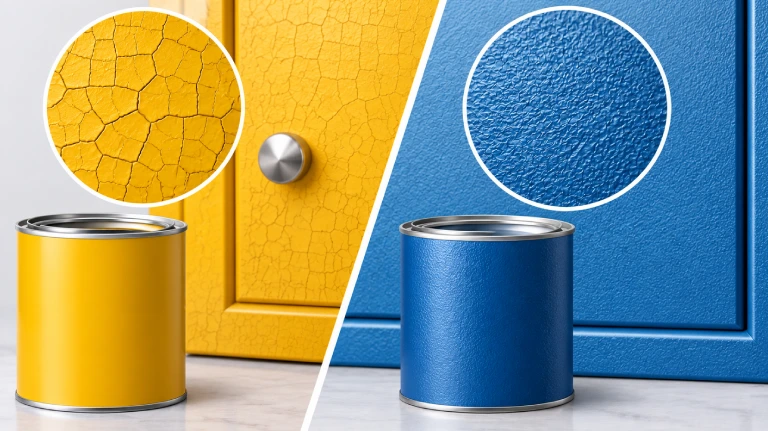
Crackle paint creates a cracked pattern that reveals a contrasting base colour, so it is mainly decorative. Wrinkle paint creates a raised, ridged, leather-like texture, so it suits tougher parts and hides surface flaws. Choose crackle for visual effect on decor, wood and interiors. Choose wrinkle for durable, textured metal components.
Buyers often confuse the two because both are “textured” finishes. If you are sourcing, our overview of Crackle Paint Manufacturers in India shows what to expect from a reliable supplier. This guide explains how the two finishes differ in practice.
What Is Crackle Paint?
Crackle paint is a two-layer system. A base coat gives the background colour and a crackle top coat splits as it dries, forming fine cracks that reveal the colour beneath.
The effect depends on contrast. A dark base under a light crackle layer looks very different from the reverse. Crack size usually depends on how thickly the top layer is applied.
Common uses include decor, furniture, picture frames, signage, musical instruments and interior accents.
What Is Wrinkle Paint?
Wrinkle paint forms a raised, ridged pattern as the film cures. The surface wrinkles because of how the coating shrinks and sets, not because a second layer cracks.
Patent records at the U.S. Patent and Trademark Office describe wrinkle finishes as ridged patterns resembling animal hide and distinguish them from ordinary rough texture finishes. They also note uses on heat-exposed metal parts.
Typical uses include engine covers, instrument housings, tool cases, enclosures and machinery panels.
Crackle Paint vs Wrinkle Paint: Side-by-Side Comparison
| Factor | Crackle paint | Wrinkle paint |
| How the effect forms | Top coat splits over a base colour | Film ridges and shrinks during cure |
| Look | Cracked, vintage, two-tone | Ridged, leather-like, uniform |
| Main purpose | Decorative | Decorative and protective |
| Typical substrates | Wood, MDF, decor, some metal | Mostly metal parts |
| Curing | Often air-dry or low heat | Often heat-cured |
| Hides surface flaws | Moderately | Very well |
| Touch-up | Easier on decor items | Difficult, often a one-shot finish |
| Wear resistance | Usually needs a clear coat | Generally strong without one |
Product behaviour varies by formulation. Check the technical data sheet.
Which Finish Should You Choose?
Start with the surface, then consider wear and the look you want.
For Furniture and Wood Products
Crackle paint gives wood and MDF an aged, handcrafted look. It suits accent pieces, cabinets and decorative panels. Add a compatible clear coat on tabletops and other touch points.
For Automotive and Industrial Parts
Wrinkle finishes are a strong fit for brackets, housings and covers that see handling and wear. The texture hides tooling marks and minor scratches.
For Construction, Retail and Decor
Crackle works well on signage, display units, wall art and interior fittings where appearance leads. Dealers can stock a small colour range and let customers mix base and top coat combinations.
For DIY and Individual Users
Crackle is the more forgiving choice for hobby projects. Wrinkle usually needs controlled heat and film thickness, which is harder at home.
For Marine and Specialty Segments
These uses need extra care. Ask for data on moisture, UV and salt exposure rather than assuming a decorative finish will hold up.
Practical Tips That Change Results
From real finishing work, these points decide whether a pattern looks right:
- Film thickness: Too thin or too thick changes crackle size and wrinkle depth.
- Temperature and cure: Wrinkle patterns are sensitive to oven or drying conditions.
- Base coat colour: In crackle systems, contrast drives the whole look.
- Primer choice: Some wrinkle finishes work best without a primer, so follow the data sheet.
- Clear coat: A topcoat can protect crackle, but may flatten the texture of a wrinkle finish.
- Surface cleaning: Oils and contamination ruin both finishes.
Always run a sample panel on your own part before bulk production.
Climate Matters: Gujarat, Africa and Sri Lanka
Humidity, heat and monsoon moisture change drying speed and adhesion. A crackle pattern that looks perfect in a dry workshop can behave differently in a humid one.
If you supply to Gujarat, other Indian states, Africa or Sri Lanka, share your working conditions with your supplier. Also check packaging and shelf life for longer shipping routes.
How to Choose a Crackle Paint Manufacturer
Look for proof, not just claims:
- Technical data sheets and safety documents on request
- Sample panels showing the pattern on your substrate
- Repeatable results across batches
- Clear guidance on base coats, thickness and curing
- Reasonable lead times. A crackle paint manufacturer in Ahmedabad or elsewhere in Gujarat can often deliver faster to domestic buyers.
Whether you need a crackle paint supplier in India for a single product or a recurring supply, request a trial batch first.
Final Thought
Pick crackle when the pattern and colour contrast are the point. Pick wrinkle when you need a durable, textured finish that hides flaws on metal. In both cases, preparation, thickness control and a transparent supplier decide the result.
Need help matching a finish to your product? Nano Polycoat can guide you on options, samples and application support.
Frequently Asked Questions
- What is the main difference between crackle paint and wrinkle paint?
Crackle paint forms a cracked pattern that reveals a contrasting base colour underneath, usually as a decorative air-dried effect. Wrinkle paint forms a raised, ridged, leather-like texture, typically during baking. Crackle is mainly about visual contrast, while wrinkle is about texture, durability and hiding surface flaws. - Which is more durable, crackle or wrinkle finish?
Wrinkle finish is generally more durable because the textured film is thick and hides scratches and wear well. Crackle finishes are mostly decorative and usually need a protective clear coat on high-touch surfaces. Always check the technical data sheet for abrasion and weather resistance. - Can wrinkle paint be applied on wood?
Many wrinkle finishes rely on heat curing, so they suit metal parts better than wood. Wood is better served by crackle effects or textured coatings made for wood. Ask a crackle paint manufacturer about wood-compatible systems and sample panels before choosing. - How do I find a crackle paint manufacturer in Ahmedabad?
Look for a crackle paint manufacturer in Ahmedabad that offers sample panels, technical data sheets, colour options and application guidance. Ask about base-coat compatibility, drying times and batch consistency. Visiting the facility or requesting a trial order helps you verify quality before bulk purchase. - Do crackle and wrinkle paints need a primer?
Crackle systems generally need a compatible base coat and the primer must suit the substrate. Wrinkle finishes can behave differently, as some are applied without a primer because it may alter the texture. Always follow the manufacturer’s data sheet for your substrate. - Can a crackle paint supplier in India serve Africa and Sri Lanka?
Many Indian suppliers export to Africa and Sri Lanka. Confirm packaging, shelf life, safety documents and shipping terms and request a trial batch. Hot, humid climates affect drying and adhesion, so share your substrate and conditions with your crackle paint supplier before ordering.