

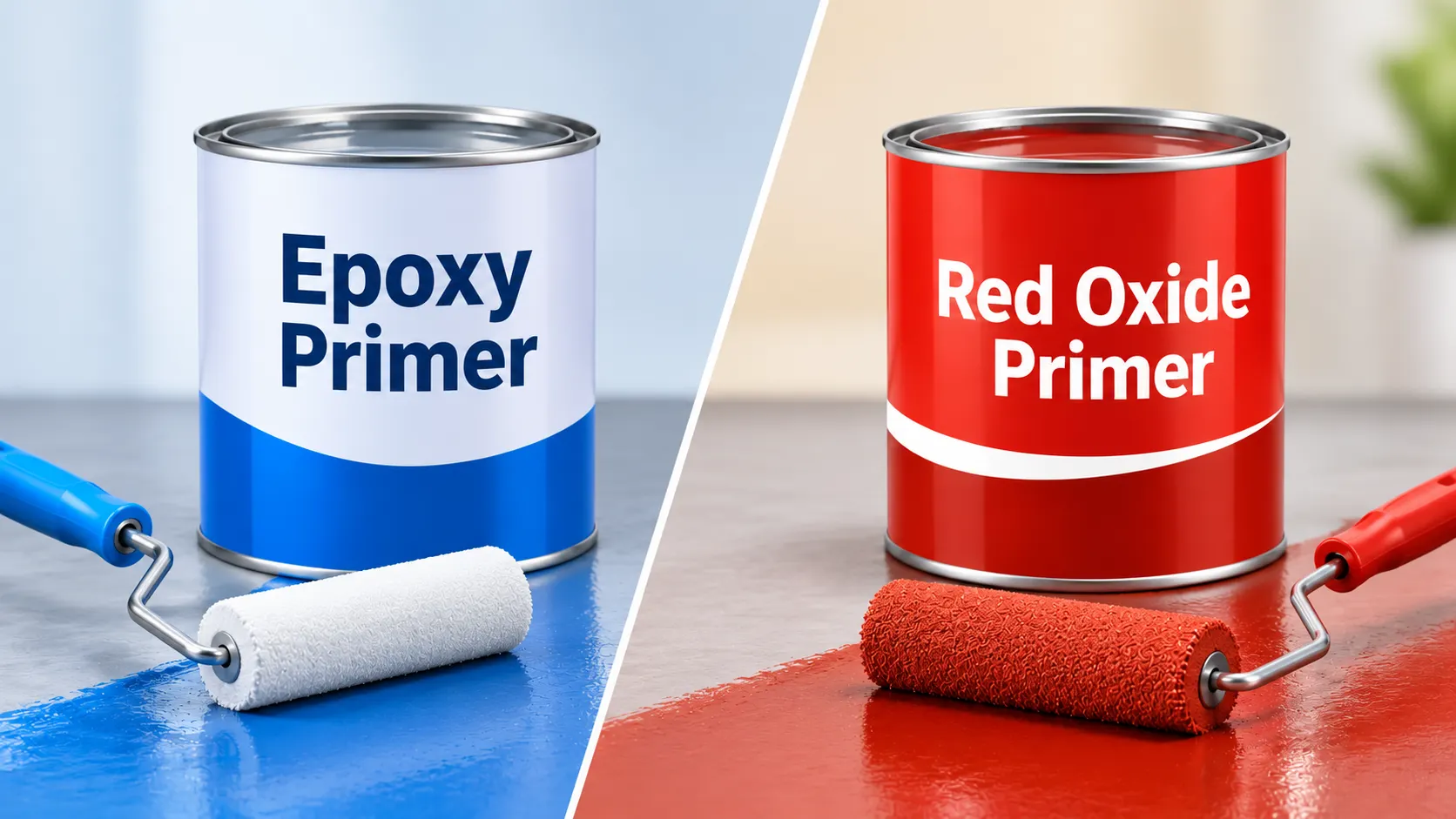
Choosing the wrong metal primer can lead to early rust formation, paint peeling, repeated maintenance and unnecessary project expenses. So, which is better: epoxy primer or red oxide primer?
Epoxy primer is generally the better option for demanding industrial applications, high-moisture exposure and chemical environments. Conventional red oxide primer is often a more economical choice for general metal fabrication, gates, railings and less demanding applications.
However, the right choice depends on the metal surface, environmental conditions, finishing paint and expected service life.
If you are comparing products from Primer Manufacturers in India, understanding these differences can help you make a better purchasing decision.
Epoxy Primer vs Red Oxide Primer: Quick Comparison
Before selecting a primer for your next project, consider these practical differences.
| Comparison | Epoxy Primer | Conventional Red Oxide Primer |
| Typical resin | Epoxy | Alkyd |
| Components | Usually two-component | Usually one-component |
| Corrosion protection | Suitable for demanding environments | Suitable for general protection |
| Moisture resistance | Generally high | Formulation-dependent |
| Chemical resistance | Generally high | Usually limited |
| Adhesion | Strong on properly prepared surfaces | Good on compatible surfaces |
| Application | Requires mixing for 2K systems | Generally simpler |
| Initial cost | Generally higher | Generally lower |
| Common use | Industrial equipment, steel structures, tanks | Gates, railings, fabrication |
Important: Red oxide refers to the pigment, not necessarily the resin. Epoxy red oxide primers are also available. This comparison focuses on conventional alkyd-based red oxide primer versus typical two-component epoxy primer.
1. What Is Epoxy Primer?
Epoxy primer is a protective coating generally made using epoxy resin and a curing agent. Many industrial formulations are two-component systems that require mixing before application.
After curing, the coating forms a protective film that helps prevent moisture and corrosive substances from reaching the metal surface.
Where Is Epoxy Primer Used?
Epoxy primer is commonly considered for:
- Industrial machinery and equipment
- Steel structures and fabrication units
- Storage tanks and pipelines
- Automotive and commercial vehicle components
- Metal equipment in manufacturing plants
- Selected coastal and industrial applications
Why do industrial buyers choose it?
Its strong adhesion, barrier protection and chemical resistance make epoxy primer useful in applications where ordinary metal primers may not provide the required performance.
However, epoxy coatings have limited UV resistance and generally need a suitable weather-resistant topcoat for prolonged outdoor exposure.
2. What Is Red Oxide Primer?
Red oxide primer is a metal primer containing red iron oxide pigment. Conventional formulations commonly use an alkyd-based binder.
It provides a protective base layer for iron and steel surfaces and helps improve the adhesion of compatible finishing paints.
Where Is Red Oxide Primer Used?
Typical applications include:
- Metal gates and railings
- Window and door frames
- Mild steel fabrication
- Agricultural equipment
- General engineering products
- Metal furniture and fabricated components
Why do buyers choose it?
Red oxide primer is often preferred for projects where economical metal protection, straightforward application and compatibility with conventional finishing paints are important.
It is a practical option for general metalwork, provided the environmental exposure and product specifications are suitable.
3. Which Primer Offers Better Rust Protection?
This is one of the most important questions for industrial buyers.
Epoxy primer generally provides stronger barrier protection against moisture and corrosive exposure than conventional alkyd-based red oxide primer.
For example:
- A fabricated steel machine operating in a humid industrial facility may benefit from an appropriate epoxy coating system.
- A metal gate in a relatively mild environment may be adequately protected by a suitable red oxide primer and compatible topcoat.
- Steel structures near coastal areas may require a more specialised protective coating system.
Remember that primer alone does not determine corrosion performance. Surface preparation, coating thickness, topcoat compatibility and application quality all matter.
The Association for Materials Protection and Performance (AMPP) explains that coating selection should consider environmental exposure, surface preparation and the complete protective coating system. Read its guide on protective coatings for structural steel.
4. Epoxy Primer vs Red Oxide Primer: Which Is More Cost-Effective?
A lower purchase price does not always mean lower overall project cost.
Consider two situations:
Situation A: General Metal Fabrication
A workshop manufactures gates, railings and mild steel frames for ordinary building applications.
A compatible red oxide primer may provide adequate protection at a lower initial material cost. Using an expensive industrial coating system may not be necessary.
Situation B: Industrial Equipment
A manufacturing facility needs to coat steel equipment exposed to moisture, oil and industrial chemicals.
An appropriate epoxy primer system may involve higher initial costs, but its protective properties can justify the investment when specified for those conditions.
When comparing prices, evaluate:
- Material consumption per square metre
- Number of coats required
- Recommended dry film thickness
- Surface preparation costs
- Application labour
- Expected maintenance requirements
Compare the complete coating system rather than the price per litre alone.
5. How to Choose the Right Primer for Your Application
Use this practical selection guide before purchasing.
| Your Application | Primer to Consider |
| Metal gates and railings | Conventional red oxide |
| General mild steel fabrication | Conventional red oxide |
| Industrial machinery | Epoxy primer |
| Steel tanks and equipment | Suitable industrial epoxy system |
| Chemical processing equipment | Chemically resistant specified system |
| Coastal steel structures | Specialised corrosion protection system |
| Outdoor metal structures | Primer and weather-resistant topcoat system |
For marine exposure, heavy chemical environments or highly corrosive industrial conditions, consult the coating specification rather than choosing a primer based only on its category.
6. Five Mistakes That Can Cause Primer Failure
Even a good-quality primer can fail when the application process is incorrect.
Avoid these common mistakes:
- Applying primer over rust: Loose rust, mill scale and contaminants can interfere with adhesion.
- Ignoring surface cleaning: Oil, grease, dust and moisture can cause coating defects.
- Incorrect epoxy mixing: Using the wrong base-to-hardener ratio can affect curing and final coating performance.
- Choosing an incompatible topcoat: Always check whether the finishing paint is suitable for the selected primer.
- Ignoring film thickness: Applying too little or too much material can affect the protective coating system. Follow the recommended wet and dry film thickness.
7. What Should You Check Before Buying Primer?
Whether you are purchasing from a Primer Manufacturer in Ahmedabad, Gujarat or another part of India, ask these questions before finalising your order:
- Is the primer suitable for my metal substrate?
- What corrosion protection is it designed to provide?
- Is it a one-component or two-component system?
- What is the recommended mixing ratio, if applicable?
- Which topcoats are compatible?
- What are the recommended application and drying conditions?
- What are the specified coverage and dry film thickness?
- Is a technical data sheet available?
A reliable primer supplier in India should be able to provide clear product information and help you understand the coating requirements for your application.
These checks are equally important for buyers sourcing industrial coatings for projects in Africa and Sri Lanka, where environmental exposure can vary considerably.
Final Verdict: Which Primer Should You Buy?
There is no single primer that is best for every metal surface.
Choose epoxy primer when your project requires stronger moisture resistance, chemical resistance and industrial-grade protection.
Choose conventional red oxide primer when you need an economical solution for general metal fabrication and less demanding environments.
Before making a purchase, consider the substrate, environmental exposure, finishing coat and expected maintenance requirements.
Nano Polycoat manufactures and supplies paint and coating products for industrial and commercial applications. Contact Nano Polycoat to discuss your coating requirements and identify a suitable primer system for your metal surfaces.
Frequently Asked Questions
1. Which is better, epoxy primer or red oxide primer?
Epoxy primer is generally better for demanding industrial applications requiring moisture and chemical resistance. Conventional red oxide primer is suitable for general metal fabrication and less aggressive environments. The right option depends on the substrate, exposure conditions, compatible topcoat and required protective performance.
2. Can I use epoxy primer instead of red oxide primer?
Yes, epoxy primer can replace conventional red oxide primer in many metal coating applications, provided the substrate and complete coating system are compatible. However, epoxy may involve higher material and application costs. Select the product according to environmental exposure and project specifications.
3. Which primer is best for outdoor metal surfaces?
The best primer depends on outdoor exposure. Conventional red oxide may suit general outdoor metalwork in mild conditions, while epoxy systems are often preferred for demanding environments. For prolonged sunlight exposure, use a compatible weather-resistant topcoat to protect the complete coating system.
4. Is epoxy primer more expensive than red oxide primer?
Epoxy primer generally has a higher initial material cost because of its formulation and two-component application requirements. Red oxide primer is often more economical. However, buyers should compare material consumption, labour, surface preparation and expected maintenance costs before making a purchasing decision.
5. Can I apply paint directly over red oxide primer?
Yes, you can apply a compatible finishing paint over red oxide primer after the recommended drying period. Check the manufacturer’s technical data sheet for topcoat compatibility, surface preparation and recoating intervals. Applying an incompatible finishing coat can lead to adhesion problems or premature coating failure.
6. Which primer is suitable for industrial steel structures?
Epoxy primer is commonly selected for industrial steel structures because of its adhesion, moisture resistance and chemical resistance. Highly corrosive environments may require a complete system involving zinc-rich primer, epoxy intermediate coating and a suitable protective topcoat.
7. How do I find reliable Primer Manufacturers in India?
Compare primer manufacturers based on product specifications, substrate compatibility, technical data sheets, application guidance and supply consistency. Also evaluate whether the supplier can recommend compatible finishing coats and suitable protective systems for your industrial or commercial metal coating requirements.