
NC paint for wood is a fast-drying lacquer coating commonly used when furniture and wood products need a smooth, buildable finish. The choice between gloss and matte mainly depends on the desired appearance, furniture style, surface condition and application process.
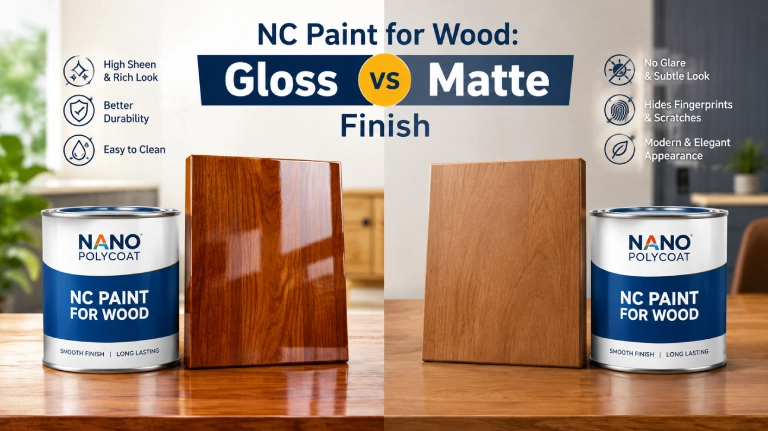
Gloss NC paint gives stronger light reflection and a more noticeable polished appearance. Matte NC paint reduces reflection and gives a softer, lower-sheen appearance. Both can be useful, but the right choice depends on the finished product rather than sheen alone.
For buyers comparing wood coatings, you can also explore NC Paint Manufacturers in India for broader product information.
What Is NC Paint for Wood?
NC paint generally refers to nitrocellulose-based lacquer systems. In wood finishing, NC lacquer is used as a film-forming coating that can dry quickly and build through multiple coats.
One useful characteristic of solvent-based lacquer is that subsequent coats can interact with earlier coats, helping create a continuous film and making some repairs easier. WOOD Magazine describes nitrocellulose lacquer as a common lacquer type and explains its fast-drying and repair characteristics.
NC coatings are commonly considered for furniture, cabinets, decorative wood components and other indoor applications where appearance and production speed are important.
Gloss vs. Matte NC Paint: What Is the Difference?
The main difference is how much light the finished surface reflects.
| Feature | Gloss NC Paint | Matte NC Paint |
| Light reflection | High | Low |
| Visual appearance | Shiny and polished | Soft and subdued |
| Surface marks | More noticeable under strong light | Often less visually prominent |
| Furniture style | Modern, decorative, polished | Contemporary, understated |
| Cleaning appearance | Smooth-looking surface | Less reflective surface |
| Finishing objective | Strong visual depth and shine | Low-glare appearance |
The actual result also depends on the coating formulation, application technique and surface preparation.
A gloss finish can make the wood surface and underlying preparation more visually obvious. Matte finishes reduce reflection, but they still require proper preparation for a consistent result.
When Should You Choose Gloss NC Paint?
Gloss is often selected when the furniture design calls for a bright, reflective surface.
It can work well for:
- Decorative furniture
- Display cabinets
- Interior woodwork
- Furniture where a polished appearance is desired
- Products where color depth and surface reflection are part of the design
Gloss also makes surface preparation important. Dust particles, scratches, sanding marks and uneven application can become easier to see because reflected light highlights surface irregularities.
A well-prepared substrate therefore matters as much as the final coating choice.
When Should You Choose Matte NC Paint?
Matte NC paint is useful when a softer appearance is preferred.
It can suit:
- Modern furniture
- Office furniture
- Cabinets
- Interior decorative panels
- Wood products where strong reflection is not wanted
A matte appearance can make a product feel visually quieter. However, lower sheen does not mean preparation can be skipped.
The coating still needs to be applied evenly. Uneven film thickness, poor spraying or inconsistent surface preparation can create variations in sheen.
Does Surface Preparation Affect NC Paint Finish?
Yes. The final appearance of an NC wood coating depends heavily on the condition of the surface underneath.
Before coating:
- Remove dust, oil, wax and other contaminants.
- Sand the wood evenly.
- Repair visible surface defects where required.
- Apply the recommended sealer or primer system.
- Sand between stages according to the product instructions.
- Remove sanding dust before spraying the next coat.
WOOD Magazine notes that film-forming finishes such as lacquer can fill sanding scratches, but the final smoothness still depends on proper finishing and levelling of the coating.
For production furniture, testing the complete coating system on the actual wood substrate can help prevent unexpected appearance differences.
How Does Application Affect Gloss or Matte Finish?
The same NC paint can produce different results when application conditions change.
Important variables include:
- Spray equipment
- Spray pressure and technique
- Coating viscosity
- Thinner selection
- Distance from the surface
- Number of coats
- Film thickness
- Drying conditions
- Temperature and humidity
This is why an NC paint manufacturer should provide product-specific technical guidance rather than relying on one universal application rule.
High humidity can also create problems with solvent-based lacquer. Moisture may condense on a cooling surface during solvent evaporation, producing a cloudy or whitish appearance known as blushing.
Gloss vs Matte: Which One Is Easier to Maintain?
Maintenance depends on the complete coating system and how the furniture is used.
Gloss surfaces can show fingerprints, scratches and dust more clearly because reflected light makes surface changes easier to notice.
Matte finishes reduce strong reflection, but they are not automatically more resistant to scratches, chemicals, or moisture.
The intended use should therefore be considered before choosing a sheen. A decorative indoor cabinet and a frequently handled furniture component may have different coating requirements.
Common NC Paint Problems on Wood
Some application problems are not caused by the gloss or matte choice itself.
Common issues include:
Blushing
A cloudy or milky appearance can occur when moisture becomes trapped during solvent evaporation, particularly under humid conditions.
Uneven Sheen
Uneven application, inconsistent film thickness or differences in surface preparation can create visible variations between areas.
Runs and Sagging
Excessive wet film or incorrect spray technique can cause the coating to move before it dries.
Poor Adhesion
Contamination, unsuitable preparation or incompatibility between coating layers can affect adhesion.
Rough Surface
Dust, overspray, poor atomization or inadequate surface preparation can reduce smoothness.
The solution should be based on the actual defect rather than simply adding more thinner or another coat.
How Should Furniture Manufacturers Choose NC Paint?
For furniture manufacturers and wood coating businesses, appearance is only one selection factor.
Before purchasing from an NC Paint Supplier, ask:
- Is the product suitable for my wood substrate?
- Is it intended for spray application?
- What primer or sealer is recommended?
- Which thinner is compatible?
- What sheen options are available?
- What drying and recoating guidance is provided?
- Is a TDS available?
- Is an SDS available?
- Can the product be tested on a production sample?
These questions help connect the coating choice with the actual manufacturing process.
How to Choose an NC Paint Manufacturer in India
Whether you are looking for an NC Paint Manufacturer in Ahmedabad, an NC Paint Manufacturer in Gujarat, or an NC Paint Supplier in India, compare technical suitability along with price and availability.
For regular production, useful supplier-selection factors include:
- Product consistency
- Clear product identification
- TDS and SDS availability
- Compatible thinner information
- Packaging options
- Batch traceability
- Application guidance
- Regular supply capability
- Technical communication
A supplier who understands the complete coating process can be more useful than one who only provides a product name and price.
Safety When Applying NC Paint
NC paint and lacquer systems may contain volatile solvents. Application should therefore be carried out according to the product’s SDS and appropriate workplace safety procedures.
Good ventilation, suitable protective equipment and control of ignition sources are important when working with solvent-based coatings. WOOD Magazine specifically recommends adequate ventilation and appropriate respiratory protection when spraying lacquer.
Always follow the manufacturer’s current safety documentation rather than assuming that every NC product has the same hazards.
Final Takeaway
For NC Paint for Wood, gloss and matte are both useful finish options. Gloss creates stronger reflection and a polished visual effect, while matte provides a softer, lower-reflection appearance.
The final result depends on more than sheen. Wood preparation, primer or sealer selection, compatible thinner, spray technique, film thickness and environmental conditions all influence the finished surface.
For furniture and wood manufacturers, the practical approach is to test the complete NC coating system on the intended substrate and follow the manufacturer’s TDS before moving into regular production.
Nano Polycoat manufactures and supplies paint and coating products for customers in India and international markets, including Africa and Sri Lanka. Buyers can discuss their wood substrate, desired sheen and application process when evaluating an NC coating system.
FAQs
1. Is NC paint good for wood furniture?
NC paint can be suitable for many indoor wood furniture applications where fast drying, smooth appearance and buildable film are important. The suitability depends on the wood substrate, preparation, coating system and intended use. Buyers should confirm the manufacturer’s application recommendations before production.
2. What is the difference between gloss and matte NC paint?
Gloss NC paint reflects more light and creates a shinier, polished appearance. Matte NC paint has lower light reflection and provides a softer appearance. Neither sheen is automatically suitable for every application; surface preparation, coating formulation and intended furniture use should also be considered.
3. Can NC Paint for Wood be used on MDF?
NC Paint for Wood can be used on MDF when the coating system is suitable for the substrate and the surface has been properly prepared. Primer or sealer requirements can vary by product. Always test the complete system on the actual MDF before regular production.
4. How do I choose an NC Paint Manufacturer in India?
When selecting an NC Paint Manufacturer in India, check product compatibility, TDS and SDS availability, application guidance, batch consistency, packaging and supply capability. For furniture production, conduct a sample trial on the intended wood substrate to confirm appearance, drying and application behavior.
5. How do I choose an NC Paint Manufacturer in Ahmedabad?
When comparing an NC Paint Manufacturer in Ahmedabad, consider more than local availability or price. Ask about suitable wood substrates, recommended primer and thinner, sheen options, technical documents, batch identification and regular supply. A production trial can help verify compatibility before larger purchases.
6. Can humidity affect NC paint on wood?
Yes. High humidity can contribute to blushing with solvent-based lacquer because moisture can condense on the cooling surface as solvents evaporate. Application conditions therefore matter. Follow the product manufacturer’s recommended temperature, humidity, ventilation and application conditions for consistent results.
7. Is NC paint available in gloss and matte finishes?
NC coating systems can be supplied in different sheen levels depending on the formulation and manufacturer. Gloss provides stronger reflection, while matte reduces reflection. Buyers should confirm the available sheen options with an NC Paint Supplier and test the selected finish on the actual wood substrate.