
Paint thinners play a critical role in industrial coating applications, yet many buyers and applicators still treat them as secondary products. In reality, the right thinner directly affects paint performance, finish quality, drying time and equipment life.
From automotive workshops to large-scale manufacturing plants, industries rely on specialized paint thinners for consistent and professional results. This guide explains what paint thinners are, how they work, their industrial types and how to choose the right thinner from reliable thinner manufacturers.
What Are Paint Thinners?
Paint thinners are chemical solvents used to:
- Reduce paint viscosity
- Improve flow and leveling
- Control drying time
- Enhance spray application
- Clean painting equipment
In industrial settings, thinners are formulation-specific, meaning each paint system requires a compatible thinner.
Why Paint Thinners Are Essential for Industrial Use
Industrial coatings demand precision, durability and uniform application. Paint thinners help achieve this by ensuring proper paint behavior during application.
Key Benefits of Paint Thinners
- Smooth and even paint finish
- Better adhesion to substrates
- Reduced spray gun clogging
- Controlled evaporation rate
- Improved coating lifespan
Without the correct thinner, even high-quality paint can fail prematurely.
Types of Paint Thinners Used in Industry
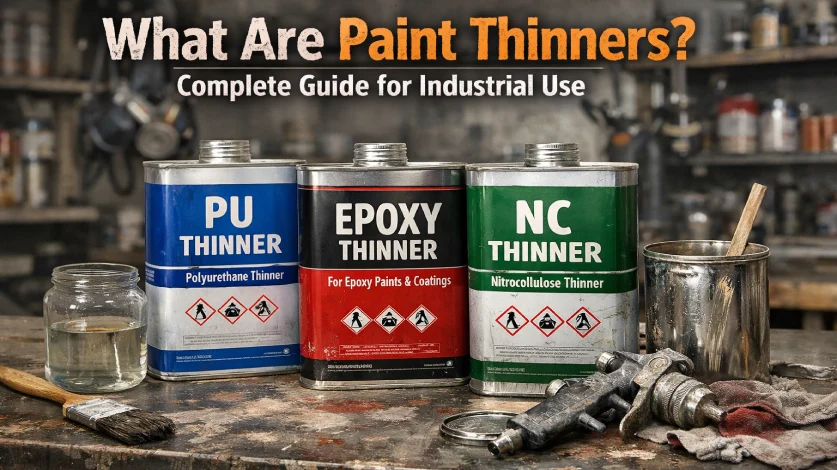
PU Thinner
PU thinners are designed for polyurethane paints and coatings.
Types of PU Thinner
- PU Thinner (Fast Dry): Ideal for cold or humid conditions
- PU Thinner (Medium): Balanced drying for standard use
- PU Thinner (Slow Dry): Used in hot climates for better flow
Applications
- Furniture manufacturing
- Automotive painting
- Industrial machinery coatings
Epoxy Thinner
Epoxy thinners are used to reduce viscosity in epoxy paints and coatings.
Key Features
- Enhances chemical resistance
- Improves surface wetting
- Maintains epoxy strength
Applications
- Industrial flooring
- Chemical plants
- Metal protection coatings
Acrylic Thinner
Acrylic thinners support fast-drying acrylic paints.
Common Uses
- Automotive refinishing
- Decorative coatings
- Industrial spray applications
Synthetic Thinner
Synthetic thinners are general-purpose solvents compatible with synthetic enamel paints.
Advantages
- Cost-effective
- Widely available
- Easy application
Specialized Industrial Thinners
Industrial applications often require customized thinner grades, such as:
- Auto Thinner – Automotive refinishing
- Stoving Thinner – Heat-cured coatings
- Melamine Thinner – Melamine-based paints
- DAA Thinner – Fast evaporation systems
- Retardant Thinner – Prevents premature drying
- Universal Thinner – Multi-paint compatibility
Common Industrial Thinner Grades
Industries often demand standardized thinner grades for consistency:
- Super Royal Thinner
- Thinner-999
- Thinner-1000
- Thinner JC 18-X
- Retardant Thinner
These grades are formulated to meet specific evaporation rates and performance requirements.
How to Choose the Right Paint Thinner
Key Factors to Consider
Paint Compatibility
Always match the thinner with the paint type PU, epoxy, acrylic, or synthetic.
Climate Conditions
- Hot climate → Slow-dry thinner
- Cold climate → Fast-dry thinner
Application Method
- Spray application needs controlled evaporation
- Brush or roller may need slower drying
Industry Standards
Choose thinners from certified thinner manufacturers in India to ensure quality and safety.
Role of Thinner Manufacturers in Industrial Quality
Reputed thinner manufacturers ensure:
- Consistent solvent composition
- Safe handling and storage standards
- Batch-tested performance
- Compliance with industrial regulations
Choosing an experienced thinner supplier in India reduces coating failures and rework costs.
Safety Guidelines for Industrial Paint Thinners
Best Practices
- Ensure proper ventilation
- Use protective gloves and masks
- Store away from heat sources
- Follow MSDS instructions
Industrial thinners are effective but require responsible handling.
Future Trends in Paint Thinner Manufacturing
- Low-VOC and eco-friendly formulations
- Customized industrial solvent blends
- Improved safety and emission control
- Increased demand from automotive and infrastructure sectors
Conclusion
Paint thinners are not just additives, but essential components of industrial coating systems. From PU thinners and epoxy thinners to specialized grades, selecting the right product from trusted thinner manufacturers in India ensures superior finish, durability and efficiency.
For industries seeking reliable performance, working with an experienced thinner supplier in India, especially reputable brands like Nano Polycoat, makes a measurable difference in coating quality and long-term operational cost savings.
FAQs
- What is the main purpose of paint thinners?
Paint thinners reduce paint thickness, improve application and control drying time for better coating results.
- Can one thinner be used for all paints?
No. Each paint system (PU, epoxy, acrylic) requires a compatible thinner for best performance.
- Which thinner is best for PU paints?
PU thinners fast, medium, or slow dry are designed specifically for polyurethane paints.
- How do I choose a reliable thinner manufacturer in India?
Look for manufacturers with quality control, technical support, standardized formulations and industrial experience.