
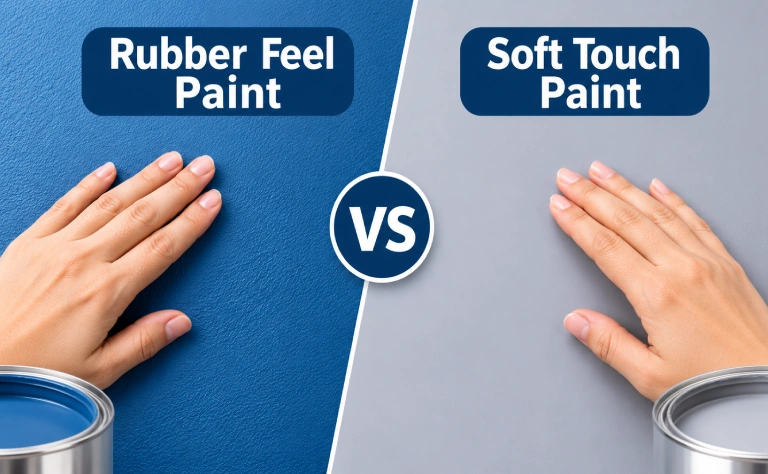
Rubber feel paint and Soft Touch paint are close relatives, not rivals. Both are soft feel coatings, usually polyurethane-based. Soft touch gives a velvety, suede-like matte surface. Rubber feel gives a grippier, more rubber-like surface. Choose soft touch for premium looks and comfort and a rubber feel where grip matters most.
Industry buyers often ask us which one to specify. The answer depends on the surface, the wear it will face and the climate. Our guide to Soft Feel Paint Manufacturers in India covers the wider category. This article focuses on the practical differences.
What Is Soft Touch Paint?
Soft Touch paint is a tactile coating that leaves a smooth, velvety, low-gloss surface. It feels warm and premium in the hand and reduces glare and fingerprints.
It is common on car interiors, electronics housings, premium packaging, furniture and cosmetic components. Most grades are two-component (2K) polyurethane or waterborne polyurethane systems.
What Is Rubber Feel Paint?
Rubber feel paint is a soft feel coating tuned for a slightly tacky, cushioned, rubber-like grip. Some versions are thicker and more flexible.
It suits handles, tool grips, sports equipment, control knobs and surfaces that must not slip. Do not confuse it with peelable rubber dips, which are temporary films rather than permanent coatings.
Rubber Feel vs Soft Touch: Side-by-Side Comparison
| Factor | Soft Touch paint | Rubber feel paint |
| Surface feel | Velvety, suede-like, smooth | Cushioned, grippy, rubber-like |
| Finish | Matte to low sheen | Matte, sometimes slightly tacky |
| Best for | Premium look and comfort | Grip and anti-slip handling |
| Typical uses | Dashboards, laptops, furniture, cosmetics | Handles, tools, knobs, grips |
| Wear concern | Scuffing, nail marks | Dust pickup, tackiness over time |
| Resin system | 2K PU or waterborne PU | 2K PU, often more flexible |
Product names vary between manufacturers. Always compare the technical data sheet, not just the label.
Which Soft Feel Coating Should You Choose?
Start with how people will touch the surface, then match the coating to the substrate and environment.
For the Automotive Industry
Interior parts such as dashboards, door panels, switch bezels and trim usually take soft touch. Specify resistance to sweat, sunscreen, UV and cleaning agents, because cabins in hot regions are punishing.
For Furniture and Wood
Wood, MDF and laminated panels look elegant under a soft feel coating. Tabletops, cabinet fronts and decorative panels benefit from a warm, matte touch. Choose a grade with good stain and abrasion resistance for daily use.
For Industrial and Manufacturing Units
Equipment housings, tool handles and machine controls often need rubber feel for grip. For consumer electronics and appliances, soft touch usually wins on appearance.
For Construction, Marine and Speciality Uses
Interior fittings, railings and cabin fixtures can use soft feel coatings where comfort matters. Exterior or marine use demands UV stability and moisture resistance. Ask for proven data, not assumptions.
For DIY Buyers and Dealers
Small projects work best with products supplied with clear application instructions. Dealers should stock a limited range of reliable grades rather than many near-identical ones.
How to Pick Between the Two: A Quick Checklist
- Touch priority: premium and smooth points to soft touch. Secure grip points to rubber feel.
- Substrate: plastics, metals and wood each need a suitable primer or adhesion promoter.
- Climate: heat, humidity and UV exposure change which grade lasts.
- Chemistry: waterborne systems help with VOC compliance. The US EPA has long treated VOCs from paints and coatings as smog-forming emissions.
- Volume and consistency: industrial buyers need batch-to-batch colour and feel consistency.
What Most Buyers Overlook: Surface Preparation
In our experience, most soft feel coating failures trace back to preparation, not the product. Oils, mould-release agents and poor sanding cause peeling and patchy feel.
A reliable process looks like this:
- Clean and degrease the substrate.
- Abrade or treat the surface as the substrate requires.
- Apply the recommended primer.
- Spray in controlled, even coats.
- Cure fully before handling or assembly.
Request a sample panel and test it on your own part before committing to bulk orders.
Climate Matters: India, Africa and Sri Lanka
Hot, humid and high-UV conditions put real stress on coatings. Sweat, sunscreen, cleaning chemicals and monsoon moisture all attack weak formulations.
If you supply to Gujarat, other Indian states, Africa or Sri Lanka, share your end-use conditions with your supplier. A good soft feel coating manufacturer will recommend a grade for those conditions and confirm packaging and shelf life for long shipping routes.
How to Choose a Soft Feel Coating Manufacturer
Product claims are easy to make, so look for proof:
- Technical data sheets and safety documentation provided on request
- Sample panels and trial batches before bulk orders
- Documented batch consistency and quality checks
- Technical support for application and troubleshooting
- Clear lead times, which a Soft Feel Coating Manufacturer in Ahmedabad or elsewhere in Gujarat can often shorten for domestic buyers
Whether you need a soft feel coating supplier in India for a single product line or an ongoing supply, ask these questions first.
Final Takeaway
Choose Soft Touch paint when appearance and comfort lead. Choose rubber feel when grip and handling lead. In both cases, preparation, climate and a transparent supplier determine how long the finish lasts.
Need help matching a coating to your part? Nano Polycoat can guide you on grades, samples and application support.
Frequently Asked Questions
- Is rubber feel paint the same as Soft Touch paint?
Not exactly, though they overlap. Both are polyurethane-based soft feel coatings. Soft touch paint gives a velvety, suede-like matte surface, while rubber feel paint leans toward a grippier, more rubber-like texture. Many manufacturers use the terms interchangeably, so always check the product’s technical data sheet. - Which soft feel coating is better for car interiors?
Soft touch coatings are usually preferred for car interiors such as dashboards, door panels and trim. They give a premium matte feel, resist fingerprints and cut glare. Choose a grade tested for sweat, sunscreen and UV exposure, since cabins in hot regions stress coatings heavily. - Can soft feel coating be applied on wood and furniture?
Yes. Soft feel coating works well on wood, MDF and laminated furniture when the surface is sanded, sealed and primed first. It adds a smooth, warm touch and reduces glare. For tabletops and handles, pick a formulation with good abrasion and stain resistance. - How do I choose a soft feel coating manufacturer in India?
Look for a soft feel coating manufacturer that shares technical data sheets, offers sample panels, controls batch consistency and supports your substrate, whether plastic, metal or wood. Ask about adhesion testing, VOC levels and after-sales help. A manufacturer in Ahmedabad or Gujarat can also shorten lead times. - Does soft touch paint last on high-contact surfaces?
Quality soft touch paint lasts well on high-contact surfaces when applied correctly on a prepared substrate. Durability depends on the resin system, film thickness and curing. Two-component polyurethane grades generally resist wear, sweat and cleaning better than basic single-component options. - Can a soft feel coating supplier in India export to Africa or Sri Lanka?
Many Indian suppliers export coatings to Africa and Sri Lanka. Confirm packaging, shelf life, safety documents and shipping terms upfront, and request a trial batch. Hot, humid climates need grades with strong adhesion and UV stability, so share your application conditions before ordering.